Categories
Uncategorized

FICTION BOOK REVIEW – ‘The Bible’

FICTION BOOK REVIEW: “The Bible”

Joe Greathead

Joe Greathead is a book reviewer, development editor (and occasional classical harpist). He has covered fiction and non-fiction for The New Yorker, Vanity Fair and Vice (amongst others). 

After recently concentrating my literary appetite upon the darkly realistic, Booker-Prize-winning Flesh by David Szaley, I thought I owed it to myself to dip my toes back into something less literary and more commercial for a change. Following the effusive recommendation of a dear friend, I have decided to read a book that has had quite strong international sales for actually quite a long time, apparently – an anthology-type text full of all sorts of different fantastical stories, ranging from the whimsical to the downright macabre. There are volumes of information similar in tone and content to a modern self-help book (but with some honestly quite startlingly off-kilter recommendations, such as removing the tip of a babies’ penis – gosh!). About halfway through, it reverts to the story of a young man from Galilee with a typical rags to riches story arc (though I won’t spoil the ending – suffice to say there’s a twist, and you won’t be ‘cross’).

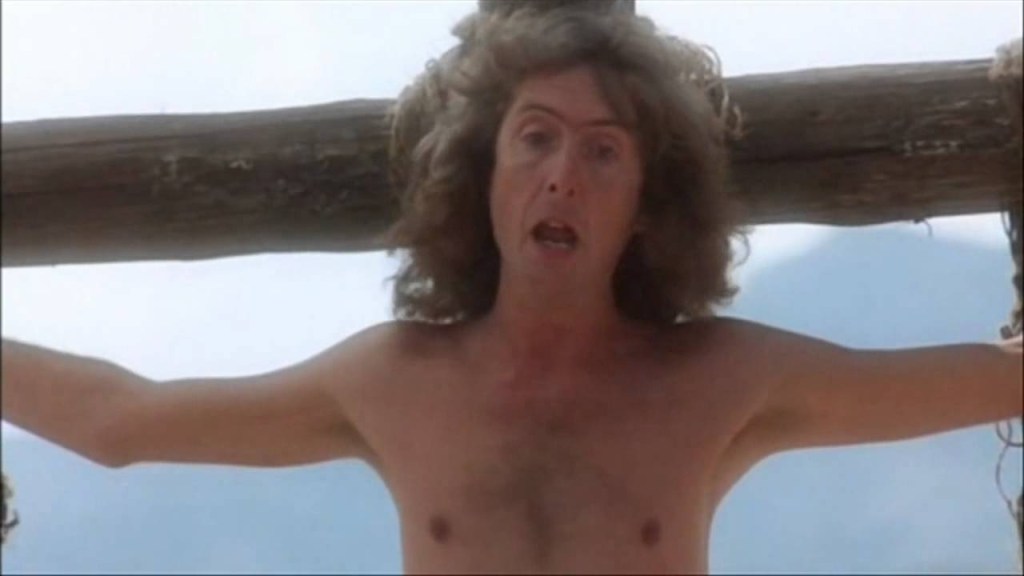
Pictured: ‘Jesus Christ’ – the key protagonist of the second part of this book

As a work of fiction, it functions mainly as a work of magical realism; often in the naive style. Often it also veers into the realm of classic fantasy. Large portions have been written in a very basic cadence – almost childlike – and whether this is a conscious creative choice or indicative of the authors’ writing ability is anyone’s guess. In parts – I’m somewhat reminded of The Wind in the Willows; and I wonder if any of the authors had indeed read the works of J.M Barrie. Possum Magic is another story in which I recognise some similarity. Though I’m not – I’ll admit – very informed of when this book was written or indeed where (you’ll have to excuse my lack of research – I’m on a rather sharp deadline). But overall I would rate the linguistic and thematic complexity as considerably more basic than a typical Young Adult fiction novel (though some of the more gory moments might keep the more sheltered twelve year-old up at night).

Though simple as it may be – frustratingly that doesn’t seem to guarantee readability. I must admit, at multiple junctures while reading this tome, I was ready to throw the book in the slush pile. Finding out – after reading two of the ‘gospels’ – that they all tell slightly different versions of the same story – was frustrating to say the least. Stylistically to have multiple narrators of the same events is arguably an interesting and somewhat innovative choice; however there was very limited new information introduced with each retelling. It was – a little exhausting – to tell you the truth. The text could vastly benefit from a judicious editing, taking to heart Stephen King’s essential piece of writing advice – to ‘kill your darlings.’ Which means – if it doesn’t serve the plot – it shouldn’t stay on the page (even if you love the way the words sound – or you think it’s particularly clever – sometimes especially so).

Interestingly – The Bible has – I’m told – about 40 registered authors – so structurally, the book resembles somewhat of a short story collection. But that is only for the first half of the book. The second half then tells the story of a young man; a carpenter by trade, who somehow acquires magical powers, forms a rag-tag group of pals, travels throughout the Middle-Eastern world helping people – culminating in a rather tense stand-off with a public official (and then I really mustn’t spoil the ending – but it’s a doozy).

So – to brass tacks. I think – and I might be unpopular for this opinion – but you can probably find something better for your summer beach read. There are a few nail-biting moments (and not to mention a savage twist at the end) – but f0r me (and I like to think I speak for a somewhat considerable fraction of the reading community), I think if I was going for magical realism in my fiction, I’d be going for a Márquez, a Borges, or even a Salman Rushdie or Murakami. It’s a no for me.

Rating: two stars out of five

Categories
Uncategorized

Alfred J Dickhead of Dickery Town (a short story)

Alfred had lived his life exceptionally aware of his exceptionality. That he stood out. Marked out. Different.

But not for anything that he could be proud of particularly.

Alfred was a Dickhead. Not in the traditional sense – meaning a person who is annoying, rude or essentially obnoxious in the traditional Australian colloquial tongue.

He was a historical dickhead. He had dickhead lineage. His last name was literally Dick-head. Which was an unfortunate bit of plumage that haunted him in every aspect of his life; from the moment he woke to the last desperate sigh onto his pillow at night.

When the roll was called out in the morning at school, he would cop sniggers and guffaws. He’d even had teachers refuse to address him, convinced that it was an elaborate joke.

Sometimes Alfred felt like a joke.

He would have blonde-haired boys with aquiline noses yell out his name from across the tuckshop line, or from under their Florsheim boots after they had tripped Alfred over onto his decidedly more bulbous nose on the basketball court.

His grandmother would spout the story that the name came from a lauded ancestor – Richard “Dick” Griswalda, who was the head of the local chapter of the Boot-Mender’s Society – a prominent social society in 1500s Cardiff responsible for many of the men’s-only social gatherings and cheerfully-enforced institutional racism at that time. But Alfred knew better.

He knew that he simply came from a long line of dickheads. It was obvious.

His father, Heronimos, was a well-known dickhead; in name of course but also in temperament. He was the local council member for Dickery, and he was, while being necessarily popular enough to warrant reelection for the past twenty years, well known for his tacit support of the electorate’s millionaires and prominent businesspeople at the expense of just about anyone with a blue collar job, a lower income or who he deemed unhygienic for reasons that seemed to change with his mood. He had been publicly flagellated in the media several times for clumsy extra-marital affairs, taking a bribe from a prominent entrepreneur in the penis-sheathing industry inexplicably and uncommercially attempting to make paper condoms a thing, and for various utterances of bigoted viewpoints about left-handed people being naturally deviant and generally untrustworthy. But since he had always run unopposed, (the residents of Dickery were notoriously not civic-minded and often drunk) these grievances never stopped him getting back into power.

His grandfather Bertrand, while not publicly awful, was nonetheless a prodigious dickhead in his private affairs, including the capricious ways in which he chose to discipline his children (like confiscating their bicycle seats, or forcing them to skip school to listen to 6 hours straight of Rodney Dangerfield in the backyard shed), and treat his wife, who he cheated on religiously. A pathological gambler; he was known to find a bet so irresistible even to the point of famously placing a wager on the colour of the garbage collector’s slacks. He reportedly placed $4,000 on chanteuse blue, causing many to speculate that he didn’t actually love gambling – he simply loved losing. Confusingly, he was also an innovative and talented businessman, running several supermarkets and Dickery’s only brothel catering to men with foot fetishes; which was why society gave him the necessary social grace to carry out his more serious acts of dickheadery with limited consequence. Money was either feast or famine in the Dickhead house; for as impressive Bertrand was at generating hard currency, his ability to subsequently lose it at a withering pace and on ridiculous things was simply outstanding.

Whether or not becoming a dickhead was genetic or a result of living with such a crass and easily lampooned surname was a problem Alfred hadn’t been able to solve yet, but he was hoping there wasn’t something in his DNA that forced the issue. He had always wanted to live a life as whatever the opposite of a dickhead was. He wasn’t fussy, either. He didn’t have aspirations of power and glory – or money over and above what he needed to get by. 

He liked birds, scrabble and Dungeons and Dragons. He was well aware that no matter which order he combined those things, he wouldn’t logically be able to find a way to support himself financially. He would have to find something that he didn’t necessarily love as a job, if he wanted a family, and to have little Dickheads of his own one day. He knew he did – but he might consider being the first in a long line of Dickheads to take the considerably evolved and modern approach and allow his children to take his wife’s last name.

Unfortunately – in love as in life – fate seems to have a sense of humour, though it’s unclear in Alfred’s case who was laughing. Because on September 29th, 2025, Alfred met the love of his life. His soulmate, in fact.

And her name? Angela. Angela Ringstinger.

Categories
Poetry

Wrap It Up

Wrap it up
I don’t want to hate reading
You
Books are testament to my 
Slowly dwindling
Attention span

But please get 
To
The
Point

It’s not 
Your fault
Dear author

My dopamine
Is 
Smithereens
Thanks to
Monkey vids
On multiple
Screens

You’ll need
Something special
To assuage
The necessarily
ADHD reader
In this
Day and 
Age

Categories
Novel-in-progress

Dr. Herman’s Predicament

Note: this story will be serialised on royalroad.com if you would like to read further chapters in the coming weeks. Visit https://www.royalroad.com/profile/328384/fictions to read more.

Chapter One

Far away, in a world not unlike this one, a young furry creature began to gain the power of insight.

It wasn’t so much of a ‘now I know how protons and neutrons converge to form atoms’ sort of insight, but more of a ‘I feel rather like I could quaff down a large amount of cheese and crispbread, and I wonder if there’s anything good on the telly’ type of thing. Which was quite unnerving for this tiny, miniature, decidedly un-statuesque, and all-over hirsute alien creature, for no other reason than the concepts of cheese, crispbread and telly (and whether there was anything on one) were entirely foreign to it. As well as that, for that matter, was the ability to form thoughts in sentences in an entirely stuffy, foreign language – and even the concept of language altogether, since before now, this really quite miniscule animal, had previously only communicated through telepathy in a sort of futuristic binary code.

Nevertheless, this teeny little fuzzball with legs brushed off these strange thoughts, and went about his day, which involved hunting for even tinier creatures in the underbrush, right at the bottom floor of a heaving forest canopy, located in an tropical rainforest on a completely foreign and undiscovered planet. But try as it might, it couldn’t seem to shake a strange craving for a nice big helping of strawberry sponge cake, and a fast game of french cricket in a Salisbury backyard.

As it happens, in fact, this wasn’t a particularly isolated event. All over this small, lusciously green (with hints of purple, red and lovely big blue oceans) planet, other creatures of great and small statures (and several species of semi-conscious moss, too) were starting to think in a way that could only be described as, well, English.

Tall flamingo-esque-looking animals with boggly eyes and wings made of a sort of skin meshed like crepe-paper began arguing about the average goal scores of South London football players, and had the ineffable urge to buy a pair of sturdy wellingtons ‘because it’s a bit wet out.’ Indeed – the weather was a bit wet out, and had been for millennia – particularly since these lanky beaked beanpoles were wetland creatures who had been born in and lived their entire lives loping around in a knee-deep fluorescent bog, where constant rain was a feature, and not a bug. Bugs – or what can be passed off as bugs on this strange planet – also formed a large part of their diet, though they couldn’t help but wonder whether the whole thing was a bit unrefined, and whether they could be better enjoyed crushed into a pate and spread onto crackers.

A colossal mammoth-like creature (though in this instance, with tusks where their eyes should be and eyes where their nostrils ought to be located), in much the same way had felt an undeniable urge to read up on the misgivings and latest pratfalls of something inexplicable named the royal family in the equally as inexplicable tabloid press, as well as the private lives of certain reality TV show contestants (all concepts that appeared with no logical context for which they could base their understanding on). Which was particularly inconvenient for the mammoth-like creature, since at that very moment, it was being coaxed onto a cliff-edge by a tribe of bipedal simians with spears, presumably so that they could use the height of the cliff to off the poor creature and eat it.

But the mammoth shouldn’t have worried, because this cosmic explosion of Englishness hadn’t missed his tool-using upright-walking pursuers. Who were all struck with embarrassment at the loincloths they were wearing and began asking each other where the nearest TopShop was so they could buy a smart pair of jeans, a T-Shirt with a logo on it and some crisp white sneakers. When one of the hunting party realised that he didn’t have a watch on, it caused instant pandemonium amongst their ranks, as the watchless hominid became immensely panicked that it didn’t know whether or not he’d missed the latest episode of EastEnders, which he had been most looking forward to watching.

Meanwhile, on another mostly green and blue planet many light years away – known as Earth – a brilliant but absent-minded scientist named Herman Smithy turned beet-red onstage in front of a rather large audience of billionaires. After receiving many millions of dollars of funding over many years, he had been absolutely sure that that the machine that he and his team of thousands of physicists, engineers and mathematicians had built would certainly have done it’s job – that job being to upload a rat’s consciousness to a computer, therefore giving it the gift of a figurative immortality (for as long as the computer wasn’t turned off, or the memory was wiped, that is). And it was particularly embarrassing, since many of his billionaire benefactors were particularly invested in the applications of this sort of technology in how it could potentially be applied to themselves (and their favourite mistresses), because they hadn’t spent all this time accumulating all that hard currency just to leave it to their snivelling progeny.

Sadly, instead of the fabulous spectacle he expected to occur, Herman’s rat sat in his cage, hooked up with wires to the computer, defiantly in possession of his own mind. It remained rat-like in its behaviour, doing ratty things, like sniffing about and scratching itself while the computer screen above, which was supposed to now display a life-like rat avatar, remained disappointingly blank, save for an error message that Herman hadn’t seen before.

But in fact, Herman’s experiment wasn’t entirely without consequence. At that exact moment, millions of Britons had woken up that day with an urge to live like animals – very strange animals. In fact, over the next few hours, unbeknownst to Herman and his cadre of Billionaires, complete and utter chaos was beginning to spread across the entire country, as people dropped what they were doing and started sniffing lamp posts, galloping like wildebeests and trying, with limited success, to fly. Sadly, and in particular for those who had taken to learning to fly, one of the immediate consequences of this was that the mortality rate nation-wide went up significantly, and continued to accelerate as the hours went on. People had begun to adopt the different characteristics of different animals on an African Savanna – each separating into groups based on their perceived order in the food chain, and acting accordingly. Some people hid, some people grazed – and some people hunted.

The exact point where Herman knew that something had gone wrong was around about 12pm, after he had managed to get home unscathed (he had certainly noticed some people acting strange, but nothing entirely out of the ordinary – he did live in South London after all). But when he noticed his elderly neighbour, Edwina Higgins, with her arthritic fingers in a claw-like grip around one of the very top branches of the Elm tree on his side of the fence, he started to think that perhaps something had gone awry. He watched in wonder as she quite happily stripped pieces of bark off the tree trunk, licking the ants that she found there and eating them.

It was at this point that the beginnings of a realisation started to pour into Herman’s head. It went something like this:

Edwina Higgins = acting like monkey

(this = strange)

‘Mrs Higgins,’ he started feebly. Are you alright?’

Mrs Higgins turned quickly and inspected Herman, quickly deciding that he wasn’t of interest. She then made an aggressive hissing noise and continued on with her business of eating ants and holding onto branches.

‘Do you want me to call Derek? It’s just that you’re awfully high up in that tree there, and I don’t think it’s awfully safe, especially at your age.’

Derek was Mrs Higgins’ son the Doctor. Mrs Higgins now paid a bit more attention to Herman, this time beating her chest and hooting at him. Herman immediately regretted his remark about her age.

‘I think I’ll call Derek. Not to worry, help is on the way.’

As Herman started dialling Derek’s number into his phone while fixing himself a nice cup of tea, his mind began to oscillate some more, going something like this:

My experiment = mind transfer

(This = similar to Mrs Higgins’ behaviour)

The phone rang out. Herman left a polite voicemail, while peering out the window at Mrs Higgins, who had now taken to licking her cardigan with great enthusiasm. The mind cogs whirred again, this time with a soupcon of anxiety creeping into Herman’s subconscious. The manner of the whirring of the cogs went again something like this:

My experiment = failure on rat

Experiment success on Mrs Higgins?

He shook off that thought. What a terrible thought indeed. It couldn’t be seriously considered – the math was solid. But then again, not solid enough to warrant a success in his presentation. What if he was off in his calculations?

Herman hesitantly picked up a yellow marker he had been using to mark use-by dates on his tupperware, and began to slowly write out – on the window – the mathematical equation by which his contraption performed the processes that…(and it all gets rather complicated from there really and it doesn’t bear going into frankly) made the thingies (language dumbed down so as to not alienate anyone reading this) work in his machine. As Herman kept one wary eye on Mrs Higgins outside, who was now swinging lithely from one branch to the next (particularly commendable for a woman of 89), his writing became more furious, and more desperate. His thinking went a bit like this:

Equation = must be right

But,

Experiment = failure

Therefore,

Equation must be wrong

At a certain point, the entire window was filled with a long, overly complex mathematical equation, and at the very end, a single character was circled. Herman considered the implication of this character, and realised, to his horror, that he had forgotten to carry the one, which was entirely a ridiculous sort of mistake for Herman, someone in possession of 3 Phd’s to make, and one that sadly and immediately made Mrs Higgins’ behaviour make sense all at once, and all at once Herman felt a smidge concerned.

For to forget to carry the one would – instead of concentrating his Theta Ray at a simple rat, would instead cause the Theta Ray to travel back into the electricity source, and then out along electrical lines, which link up with telephone lines, with link up with cellphone towers, which would transmit brain swapping rays out indiscriminately, all across mainland Britain presumably.

Suddenly Mrs Higgins’ behaviour made a terrifying amount of sense, and Herman was unable to enjoy the fact that his machine most certainly worked, largely for the fact that due to a simple failure of arithmetic, the entire of London has been exposed to a completely proprietary, entirely dangerous mind swapping technology. 

Herman consoled himself briefly with the idea that perhaps the problem was only limited to his own backyard, though a quick check of what was going on in the street outside his home confirmed that he was woefully, horribly incorrect in that assumption. His thinking at that point went along the lines of:

Herman = in a bit of a pickle.

Categories
Poetry

Christmas ham

Daddy’s into conspiracies now
He stays up at Clareville
When we’re having a row

There was money around 
But it’s all gone now

There’s a house up on Telegraph Street
With a dozy old boar
And it smells of old feet

And brave Grandpa Jim
Flew alone in a tin
(But I never knew him)

Categories
Poetry

Inbox Zero

Monday morning
Drones are yawning
Managerial emails fawning
Executive function slowly dawning
The weekend we are freshly mourning

A birthday card for you to sign?
That guy you haven’t met yet? Fine 

A shouty tome from tech support
Please do refer to this report
And try to write a quick retort
From your plastic business fort.

Categories
Poetry

Big Night Buddy?

Big night buddy? I ask
As you sit there softly
Vomiting into your Breton
Sweater.

Happy Sunday mate – you look like
You could use a coffee.
You’ve done all your flourishing
You’ve been a social butterfly
But now your wings are clipped.

Build yourself a cocoon of 
Powerade and doonas.
Sleep away the embarrassment;
Your hangover your only reward.

Go on, brave warrior
You’ve earned 
Your rest.

Categories
Poetry

The Gad-About

Don’t be jealous of the gad-about
He thinks he’s largely fine without
A grounding force, a nest to lie
From honest love he’ll always fly

But fun it is til time approaches
The listless cunning grey encroaches
Suddenly there’s no-one left
He’s got free time, but love bereft

He wonders where his love will be
The years and months to pass
Discovering that time itself
Dies off like brittle bark

Categories
Poetry

Here’s to being ordinary

Don’t be afraid of being ordinary
With an ordinary life, you get:
Two legs for running,
Two arms for climbing.
Two eyes for winking.
You get food
You get dogs
And movies.
You get a new pair of shoes
When you can afford it –
You get to work (and get paid for it).
You get to daydream
And whistle
So don’t be silly.
Enjoy your extraordinary,
Ordinary life.

Categories
Poetry

I hate it when a series ends.

Why did we watch that show so fast?
The characters were all top-class!
The characters are now my friends,
I hate it when a series ends.

I didn’t like it at the start;
It slowly won my fickle heart.
It took three eps to get into it;
We took a break but got back to it.
Now it’s gone, we’ve watched it all!
It went so quick, and now I’m bored.

How will I find another show,
As good as this? I’ll never know.
This happiness I took for granted;
This TV show had me enchanted.

There’ll never be a show like that;
If there is, I’ll eat my hat!
The comedy was just sublime,
I s’pose we could check Am’zon Prime?
(we prob’ly could check Am’zon Prime).
I wish we could go back in time.

If I could send a letter through,
To Netflix and the people who
Decide how long their shows should be:
If you make two – why not make three?
If you make eight, why not make ten?
I hate it when a series ends.

I’ll never learn to laugh again,
There’s nothing left to watch again.
Oh wait…I think I know that guy!
He’s in that show we like, oh my!
I think we should give this a run,
It’s HBO I think – oh, hun…

The death of fun was premature,
The preview doth have some allure,
Some snacks we may as well procure;
(I think the guy’s a known auteur).
I think I’ll learn to live again
This show with Jav-i-er Bardem
There’s new TV to watch, again
(Until it bloody ends again).